Wednesday, February 1, 2012

February Nature Net News - Glaciers

"The glacier was God's great plough set at work ages ago to
grind, furrow, and knead over, as it were, the surface of the earth"
Louis Agassiz
Dear Reader,

The Wisconsinan Glaciation happened around 12,000 years ago and was the last age of the mighty glaciers. A huge ice sheet covered most of Canada, the upper Midwest and New England - and it was named after Wisconsin!

These mighty masses of ice and gravel traveled across the land, straightening and shaving the land. When they melted, they left behind their debris, creating some unique and beautiful landforms. The evidence still remains today in many a state trail or wooded valley.

Wisconsin happens to be home to some of the world's finest examples of continental glaciation. Check out these ancient, natural wonders and learn how they shaped our world today in the latest issue of Nature Net News.

Enjoy!

Kathe, Sarah & Brenna
The Folks at Nature Net

Did You Know..... 
 A glacier is a river of ice that moves under the pressure of its own weight. Even though they move verrry slowly, glaciers are constantly changing and flowing.

Approximately 10% of the Earth today is covered by glaciers; during the last Ice Age, they covered one-third of the Earth’s surface.

Today's glaciers store about 75% of the world's freshwater. 

What To Do This Month:
 Hike parts of the Ice Age Trail to see remains and landforms left by the Wisconsinan Glacier across the state.

Visit the UW-Geology Museum to learn about glaciers and imagine yourself in the Ice Age. Family-friendly Storytime is on first and third Thursdays at 10:30am.

Watch PBS Kids' DragonflyTV episode on glaciers, read Perry Bear's Glacier Adventure from Alaska, and learn more from the National Snow & Ice Data Center.

Check out Nature Net's Events Calendar for other fun February ideas!

Tricks of the Trail for Parents:
Giant Glaciers
Because they are so huge and move so slowly, it's hard to imagine giant glaciers sweeping the land. Here are some tips to keep it in perspective for you and your kids:

A single crystal of glacier ice can grow to be as large as a baseball. Let's put this in perspective: a usual ice crystal is about the size of a single snowflake.

The thinnest a glacier usually gets is 50 feet (that's about the height of a 5 story building.) At its thickest point, the North American glacier was two miles tall!

Glacial periods and ice ages last for tens or hundreds of thousands of years. the Wisconsin Glacial Episode extended from approximately 110,000 to 10,000 years ago.

Instant Outdoor Expert:
Glacier Terminology
Glaciers have covered parts of North America several times throughout Earth's history, and have reshaped the landscape each time. The Wisconsinan Glacier may have melted 12,000 years ago, but there are still plenty of signs that it was here. Keep your eyes out for these glacial land features all around us!

Drumlin: Oval teardrop-shaped hill formed under the glacial ice near the advancing front of a glacier.

Erratic: Boulder or large rock carried by glaciers and deposited on the surface of the land after the ice melted.

Esker: Long, narrow ridge of coarse gravel deposited by a stream flowing in an ice-walled valley or tunnel in a melting glacier.

Kame: Created as the glacier melted in place, kames (pronounced like "came") were where debris melted through the ice, like a reverse funnel. They appear as conical hills.

Kettle: A depression formed by the melting of a large block of glacial ice that was partially or completely buried. Some kettles hold water to form kettle lakes or marshes or bogs.

Moraine: Jumbled hills of unsorted, unstratified glacial debris found at the sides or front of a glacier.
  (information from Ice Age in Wisconsin)

Featured Nature Net Site
Madison Conservation Parks
Visit Glacier Crossing Park for some real ice age evidence. This unique Madison park is on the Ice Age Trail, a thousand-mile National Scenic Trails footpath highlighting Wisconsin's world-renowned Ice Age heritage and scenic beauty. Hike the hills and discover the drumlins left during the Wisconsinan Age!

The City of Madison Parks Division Conservation Section has 14 different and unique conservation parks. A conservation park differs from other city parks in how it is managed and why the land was acquired. The goal of the conservation park is to return the land to its original state, restore native plant and animal communities, and provide education areas and opportunities for everyone.

Learn About Other Nature Net Sites

Nature Net Craft
Make Your Own Glacier!

What you need: large old bowl or container, ice cubes, dirt with pebbles in it, plate or tray, timer.

1. Put several ice cubes in the bowl so they cover the bottom.

2. Tightly pack dirt and pebbles on top until the bowl is half full.

3. Drizzle water carefully on top.

4. Leave outside overnight to freeze into a solid block.

5. Remove glacier from the bowl and set on a plate or tray. Set the timer for 10 minutes. Every 10 or so minutes, come back to see how your glacier is melting. Discuss what changes are occurring. Can you spot any "landforms" being created by your glacier?
(Nature Craft from Type-A Parent)

Nature Craft Archives

Suggested Reading:
"Glacier Babies!" by Bob Rozinski and Wendy Shattil (baby)
"Glacier National Park: An ABC Adventure" by KC Glassetter and Jeremie Hollman (preschool)
"Icebergs and Glaciers" by Seymour Simon (4-8)
"Icebergs, Ice Caps, and Glaciers" by Allan Fowler (4-8)
"The Glaciers are Melting!" by Donna Love (4-8)
"Glaciers" by Sally M. Walker (4-8)
"Exploring Glaciers" by Melody S. Mis (4-8)
"Glaciers: Nature's Icy Caps" by David L. Harrison (4-8)
"Why Do Glaciers Grind?: All About Extreme Environments" by Helen Bethune (9-12)
"Glaciers" by Larry Dane Brimner (9-12)
"Bodies from the Ice: Melting Glaciers and the Recovery of the Past" by James M. Deem (9-12)

Find Family Events on the Nature Net Calendar of Events

Monday, January 30, 2012

Who Hoots for You?


A barred owl in winter
What's that sound coming from your moonlit backyard on these winter nights? This time of year, normally-elusive owls are making themselves known as they try to attract a mate in time for their winter nesting season. Unlike many birds, who breed in the spring and summer, owls (along with animals like wolves, beavers, lynx and squirrels) are looking for love during these long, cold nights - accompanied by hoots and howls galore. Many owls begin their courtships in late January, and if you listen carefully after sundown, you might hear their mating calls from a nearby tree or telephone pole.

Five owl species regularly breed in Wisconsin, and a few others have been spotted around the state, yet their nocturnal habits, sparse distributions, and early (and chilly!) nesting periods combine to make sightings awfully scanty. From screech owls to the great horned owl, now is the time to hear or spot these cloaked crooners.

One common owl that has been making quite a racket around town is the barred owl. Learn about these raucous raptors and their jumble of cackles, hoots, caws, and gurgles - especially their distinctive "who cooks for you, who cooks for you-all" hooting. See one in action and listen to their calls. Sound familiar?
This snowy owl was spotted in Racine, WI on Dec 22, 2011.
Gregory Shaver  /  The Racine Journal Times via AP

Snowy owls, which are rarely seen south of Canada, have been reported across the northern U.S. this winter, likely being driven further south due to food scarcity in their native Arctic tundra habitat. Keep your eyes and ears out - several have been reported around the area, and a snowy owl with an injured wing was rescued from a barn near Monroe and is being nursed back to health at the Dane County Human Society. [Update: Check out this cool interactive map showing snowy owl sitings around Wisconsin!]

Pass the time until nightfall with these fun links, events and activities:

Have a hoot out there, and let us know if you hear or spot anything!

    Tuesday, January 24, 2012

    Crystals and Flakes

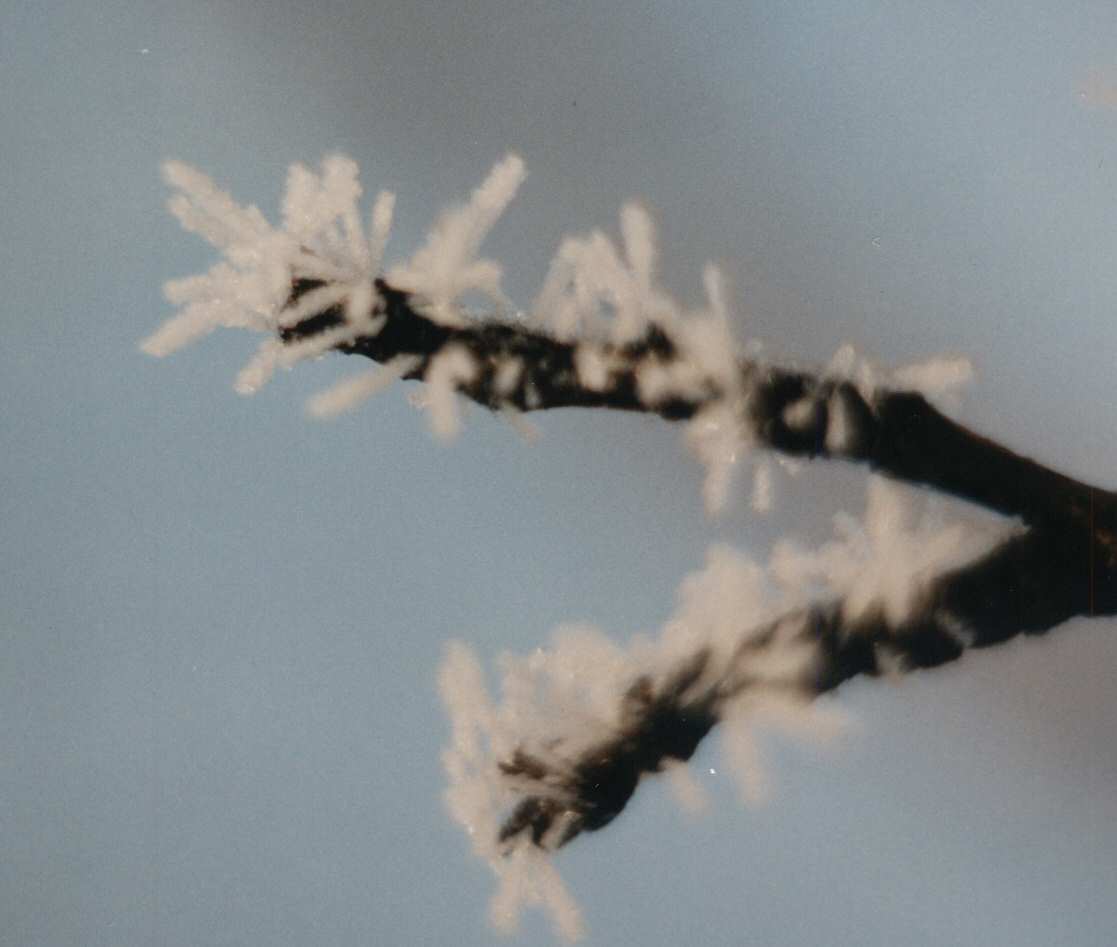
    Humid air rising from a warm river
    on a cold, still morning can form
    hoar frost on nearby trees and grasses
    From fog to flakes to frigid frosts, we have been seeing all kinds of winter weather lately. While this freezing and thawing may be frustrating for ski hills, icefishermen, and winter drivers, it does set the stage for spotting some interesting frosty phenomena with some funny names.

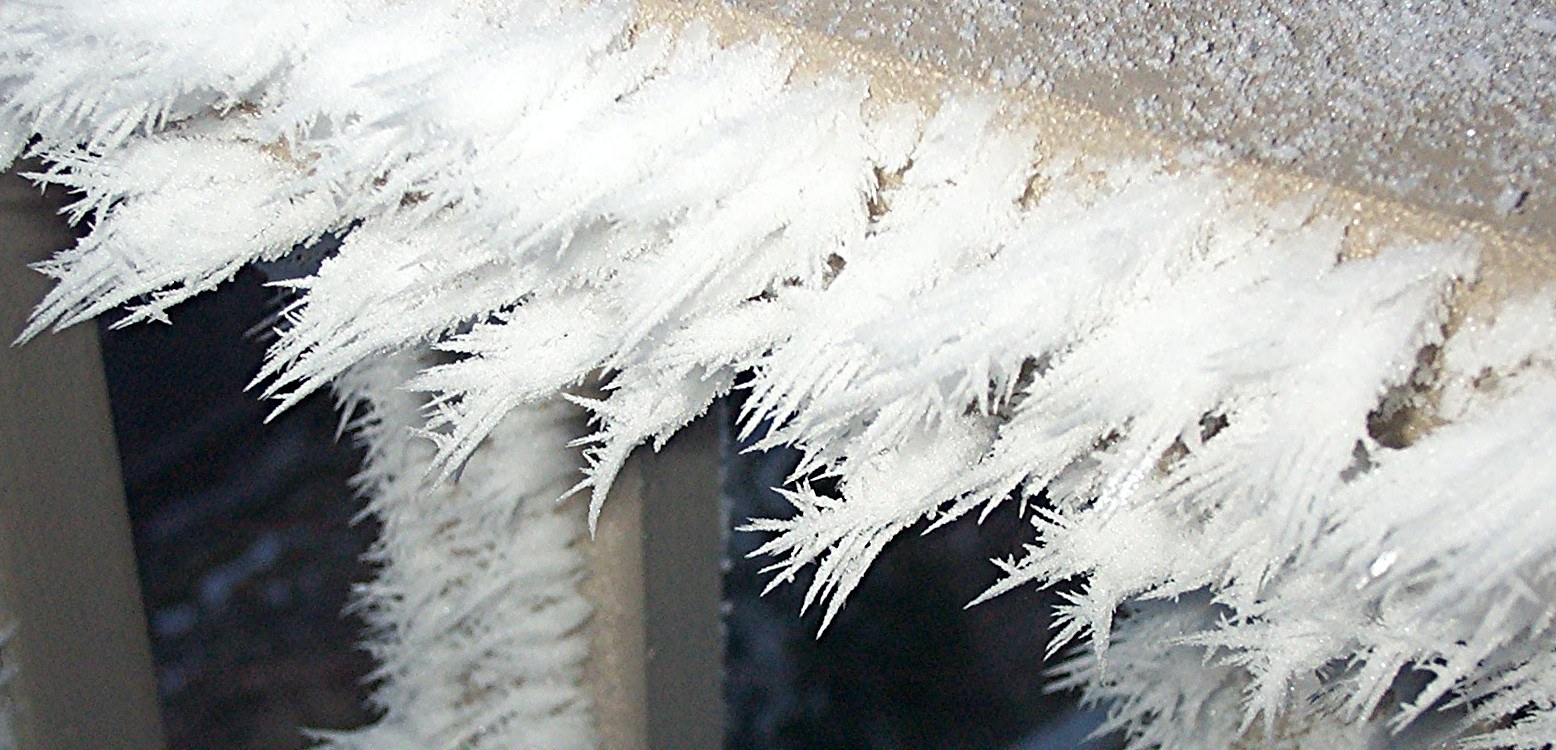
    Most people know that water condenses during cool nights to create dew, and frost is its winter companion. Shimmering ice crystals form when water vapor in the air attaches to cold solid surfaces, crusting up your lawn and drawing delicate designs on window panes. Have you ever woken up on a cold, clear morning to find the whole world covered in a beautiful white coating of hoar frost? These especially large and beautiful crystals form when water vapor in humid air settles on objects that are well below freezing, turning directly into a solid (a process called "deposition"), or becoming "supercooled" dew droplets that freeze on contact into a lacy silver or white frost.
    A close-up of hoar frost crystals.

    What happens when it's too windy for these fragile crystals to form? You might see hard rime, a milky white ice that forms when fog freezes to objects when it's cold and windy. These crystals build on each other and become shaped by high velocity wind. Glaze ice forms from freezing rain into thicker, more continuous layers, rather than individual frozen droplets. This heavy, dense, clearer ice can be particularly dangerous when it forms on roads, power lines or airplanes.

    When snow crystals in the air collide with
    water droplets in fog or clouds, they can
    yield especially interesting rime formations.
    For some frosty fun this winter, see if you can grow your own freezing formations! Put a branch or other solid object over a pan of water on a hot plate over low heat in various chilly locations. Find a still, cold spot to form hoar frost, or a high, windy spot to form rime. Adjust the height depending on the temperature and experiment with objects of different size, shape and texture to see which forms the best crystals. Check on them over the course of the next day or two and see what kind of crusty creations you have made. Be sure to snap a photo!

    Tuesday, January 17, 2012

    Intern with Nature Net!

    Are you passionate about environmental education in Wisconsin? Would you like to develop and promote resources to teachers, families and other organizations in order to enhance the education of children and expose more kids to nature? Interning with Nature Net is a great way to gain experience and get involved. Hear more from one of our past interns!

    Time Commitment:
    Responsibilities:
    • Assist Nature Net staff with regular administrative duties, including management of Nature Express (fieldtrip transportation assistance program), Earth Day Bouquet, Family Nature Clubs, mailings, correspondence, word processing, database entry, preparation of reports, meeting preparation and follow-up, filing, deliveries, etc.
    • Assist with communications and activities for Nature Net’s 16-member consortium.
    • Assist Nature Net staff in preparing and staffing outreach events, including developing and running educational activities for diverse audiences.
    • Develop and coordinate Summer Nature Passport program (multi-site family activity guide).
    • Research, produce and edit monthly and seasonal electronic newsletters.
    • Write blog posts and other promotional items as needed.
    • Update and maintain web-based products and communications, including website, Facebook, blog, and others.
    • Other duties and special projects (intern-directed projects are encouraged upon approval).
    Requirements:
    • At least 18 years of age
    • Commitment and reliability
    • Cheerful, positive and open attitude and ability to work with public of all ages
    • Flexibility and creativity
    • Interest in environmental and outdoor education
    • Excellent organization and administration skills; ability to multi-task
    • General computer skills, including social networking, html, Microsoft Office, publishing design, etc.
    • Communication skills, both oral and written
    • Reliable transportation to Aldo Leopold Nature Center and for outreach events
    Opportunities:
    • Gain experience in a highly successful, well-established network of formal and non-formal educators in South-Central Wisconsin.
    • Learn about and help to promote environmental and outdoor education throughout Wisconsin and beyond.
    • Gain valuable experience in writing, editing/publishing, program development, communications and outreach.
    • Develop and disseminate educational activities and resources for kids, families, teachers, etc.
    About Us:
    Nature Net: The Environmental Learning Network is a not-for-profit initiative that provides "one-stop shopping" for environmental education resources for teachers and families of South-Central Wisconsin and beyond. Based at the Aldo Leopold Nature Center, an independent, nonprofit dedicated to outdoor education and environmental awareness, Nature Net is supported solely to share environmental education resources and opportunities with teachers, families and other organizations in order to enhance the education of children and promote “leaving no child inside.”

    How to Apply:
    Individuals interested in this position are required to send a cover letter, resume and three references to:
    Brenna Holzhauer, Special Assistant to Nature Net and Climate Education Center
    Nature Net c/o Aldo Leopold Nature Center
    330 Femrite Drive, Monona, WI 53716
    info [at] naturenet.com / (608) 216-9375

    Friday, January 6, 2012

    January Nature Net News - Fossil Frenzy

    "When out fossil hunting, it is very easy to forget that rather than telling you how the creatures lived, the remains you find indicate only where they became fossilized."
    Richard E. Leakey

    Dear Reader,

    I was raised by a duo consisting of a rockhound and a naturalist. My parents went rock collecting for their honeymoon, and the old museum case in the living room is full of many of their souvenirs.

    I remember countless hours examining minerals and fossils with my father, enthralled as he would highlight the delicate bones of a skeletal fish, trace the veins of a fossilized fern, or rub our fingers over the bumpy shell of trilobite. It was a highlight of my childhood. 

    Fossils help us learn about conditions of the past and the path that ancestral creatures took to evolve to the animals we know and love today. For example, fossil records helped scientists determine that the Tyrannosaurus Rex is likely related to today's living chickens. So we're eating the descendants of T-Rexes every time we have chicken strips - pretty cool, huh?

    In this issue of Nature Net News, you'll learn about various types of fossils that can be found in Wisconsin and worldwide, including my personal favorite, the trilobite. 

    Enjoy!

    Sarah
    and the Folks at Nature Net

    Did You Know.....
    The trilobite is Wisconsin's State Fossil. It is the remains of an extinct marine animal that flourished when Wisconsin was covered by an ancient tropical sea.

    In addition to bones and shells, wood, plants, footprints, and scat can become fossilized.

    The oldest fossil bed in the world is the Chengjian Deposits in China. It has fossils over 555 million years old!

    We weren't kidding about those T-Rex chickens - learn how scientists are trying to use chicken DNA to reverse-engineer a "chickenosaurus"!

    What To Do This Month:
    Interested in learning more about fossils? Visit the UW Geology Museum, especially for Storytime on first and third Thursday mornings (Jan 5 and 19) - learn more below. Or click here for other family events this month.

    Looking for more fun fossil facts? Peruse the Virtual Fossil Museum!

    Want to find real fossils? Consider checking out the Wisconsin Geological and Natural History Survey's Fossil Guide for Wisconsin for an in-depth guide on the types of creatures throughout Wisconsin's past and where to find them!

    Wisconsin can be a great spot for fossil-hunting because of its unique geological history, especially the unglaciated "driftless area" in the Southwestern part of the state. You can see this area for yourself at Bethel Horizons in Dodgeville and the Aldo Leopold Nature Center's Black Earth campus - be sure to visit on January 14 for the annual Tiki Torch Toboggan event!

    Find Family Events on the Nature Net Calendar of Events

    Tricks of the Trail for Parents:
    Freaky Fossils
    Due to their skeletal nature, some children may be afraid of fossils, so be sure to point out that they're actually quite cool! Explain that these fossils are millions of years old, but still around today, and while they don't have fur or skin, they give us an amazing glimpse at ancient creatures. Speculate what might still be around millions of years in the future. What kind of creatures will be around then to discover the fossils from today?

    Instant Outdoor Expert:
    Fossil Formation
    Fossils were once living things that went through a process that turned them into the imprinted rocks they are today. The most common form of fossilization is called permineralization--this process occurs when minerals harden in the shape of an organism and create rock-like structures.

    First off, the body of the pre-fossil must become covered in water. The water protects the pre-fossil, be it animal, plant, or bone, from many deteriorating elements such as oxygen, scavenging, or sediment erosion. The flesh of the pre-fossil is eaten away by bacteria, leaving the hard parts (such as the skeleton or the exoskeleton) behind.

    Being underwater also helps with sediment deposition, or the covering up of the pre-fossil with different layers of dirt and minerals. The faster sedimentation occurs, the more likely the pre-fossil will become a fossil.

    The weight of the many layers of sediments on top of each other eventually seals off the fossil and squeezes the lower layers together into stone, a process called lithification. As this occurs, minerals in the water and sediment slowly replace the original skeleton of the pre-fossil, eventually leaving a rock copy behind.

    But how do we find these ancient buried treasures? Continental uplift is the process of the tectonic plates crashing into each other and rearranging sedimentary layers through creation of mountains, earthquakes, and the like. Erosion also removes layers of stone. Both continental uplift and erosion increase the likelihood of the fossil being unearthed by a budding paleontologist.

    Interested in how people find and unearth fossils? Check out this informative site!

    Featured Nature Net Site
    UW Geology Museum
    Explore the Geology Museum and take a peek into Wisconsin's deep history!

    On your visit, you can touch rocks from a time when there were volcanoes in Wisconsin, see corals, jellyfish and other sea creatures that used to live and swim where we now walk, and stand under the tusks of a mastodon while imagining yourself in the Ice Age. Also on display at the Geology Museum are rocks and minerals that glow, a model of a Wisconsin cave, dinosaurs and meteorites. The mineral, rock and fossil collections have the power to educate and inspire visitors of all ages - see for yourself!

    If possible, visit at 10:30am on the first and third Thursdays of the month (the 5th and 19th of January) and you can be included in the museum's Storytime, featuring a book, specimens from the museum, and a fun take-home craft!

    Learn About Other Nature Net Sites
     
    Nature Craft
    Coffee Ground Fossils

    What you need: 1 cup used coffee grounds, 1/2 cup cold coffee, 1 cup flour, 1/2 cup salt, wax paper, mixing bowl, items to make fossil indentations, empty can or butter knife, toothpicks (optional), string (optional).

    1. Mix together the coffee, coffee grounds, flour, and salt in the mixing bowl.

    2. Knead the dough together and then flatten it out on the wax paper. 

    3. Use the can or butter knife to cut out slabs for your fossil. 

    4. Place your object on your slab in order to make an indentation. When you remove it, the fossil indentation remains. Or you can draw an indentation with a toothpick. Poke a hole in the slab with a toothpick if you wish to hang your fossil. 

    5. Let dry overnight or up to two days. If you wish, use string to hang your fossil.

    (Nature Craft adapted from Kaboose)

    Suggested Reading:
    "The Great Dinosaur Mystery: A Musical Fossil Fantasy" by DinoRock (all ages)
    "If You Are a Hunter of Fossils" by Byrd Baylor (baby-preschool)
    "Fossils Tell of Long Ago" by Aliki (4-8)
    "Fossils, Rocks and Minerals" by Chris Perrault (4-8)
    "Digging Up Dinosaurs" by Aliki (4-8)
    "Fossil Fever" by Kathleen Weidner Zoehfeld (4-8)
    "Monster Bones: The Story of a Dinosaur Fossil" by Jacqui Bailey (4-8)
    "The Fossil Book" by Gary Parker (4-8)
    "The Best Book of Fossils, Rocks, and Minerals" by Chris Pellant (4-12)
    "Bones Rock!: Everything You Need to Know to Be a Paleontologist" by Peter Larson (9-12)
    "Rocks, Fossils, and Arrowheads" by Laura Evert and Linda Garrow (9-12)
    "The Fossil Factory" by Niles, Douglas, and Gregory Elderidge (9-12)
    "Fossils" by Ann O. Squire (9-12)
    "Fossil" by Paul Taylor (9-12)

    Tuesday, December 13, 2011

    Holiday Fun - Lots to Do!

    No matter what holidays you celebrate, this is the season to enjoy your family, keep the kids busy on those days off, and spend time outdoors before winter reeeally hits. Looking for ideas? There is a lot going on around town these days! Or, if you'd rather cozy up around your own house or yard, there are plenty of fun activities you can do with your friends and family. Read on for ideas...

    Out and About
    Beyond the Edge of the Sea and Seaworthy @ the UW Ebling Library and Story Time at the UW Geology Museum. Check out this traveling exhibit featuring the magnificent watercolors of deep-sea expeditionary illustrator Karen Jacobsen (Art and Science Exhibitions on display until January 31, 2012), and stop by the Geology Museum on Thursday, 12/15 at 10:30am for their family Story Time!

    Winter Solstice Celebration @ the Aldo Leopold Nature Center. Celebrate the longest night of the year with a nighttime winter hike under the stars, feed winter bird neighbors, gather around the campfire to burn a Yule log, sip cocoa and eat a seasonal solstice snack! 6:30-8pm, Friday, 12/16.

    Winter Solstice Bonfire @ Glenwood Children's Park. Help shorten the longest night of the year! Bring your mug for hot cider, snack on s'mores, listen to local music and more! 6-10pm, Sunday, 12/18.

    Holiday Concert @ Olbrich Garden. Enjoy festive "The Electric Orchestra"/Organ Music at 2pm on Sunday, 12/18. You can also see Olbrich's Holiday Express Flower and Model Train Show, warm up in the Bolz Conservatory and visit the outdoor gardens to see winter grasses and berries.

    Exhibits Sneak Peek: Special Public Hours @ the Aldo Leopold Nature Center. Stop by for a sneak-preview of brand new interactive exhibits and programs, which won't be available to the public until next Spring! Get a one-of-a-kind view of our planet's rarely seen "frozen world," explore hands-on exhibits about weather and climate, and, see the winning entry from ALNC's snow globe art contest transformed into a giant spinning snow globe! Thursday, 12/29, noon-7pm.

    Winter Wonder Week @ the Madison Children's Museum. Celebrate Wisconsin's signature season with special activities throughout the museum from January 2-7. Help build an ice sculpture, practice ice fishing, brave the Rooftop Ramble for frosted food, art and games, brush up on basic survival skills, enjoy a winter themed sing-along and a visit to the log cabin to learn what pioneers did for entertainment through the long, cold winter.

    Tiki Torch Toboggan @ the Aldo Leopold Nature Center (Black Earth Campus). Discover the winter flora and fauna as you sled, snowshoe or hike along the snow covered trails and warm up around a roaring campfire with a cup of hot chocolate. Saturday, 1/14, 4-7pm.

    At Home
    Christmas Bird Count - National Audubon Society. From 12/14 through 1/5, tens of thousands of volunteers throughout the Americas take part in an adventure that has become a family tradition among generations. Families and students, birders and scientists, armed with binoculars, bird guides and checklists go out on an annual mission.

    Winter Bird Feeders - You and your family and friends can make birdfeeders together and see what critters they attract this season! Using pinecones, pipe cleaners, milk cartons, or other household items, you can make quick and easy birdfeeders that will make the birds happy and give your family something to watch together. Keep track of what you see and enter them into the Christmas Bird Count or Earth Alive!

    Decorate with Nature - Go Explore Nature has a great list of holiday ideas that will get you outside with your family. Check out these 5 Ways to Decorate with Nature or their 24 Days of Holiday-Inspired Nature Fun.

    Track and Trail Blaze! - In case you missed December's Nature Net News, it was full of ideas for getting outside, seeing what tracks and trails you can trace, and making snow stories of your own. Check it out!

    This time of year sure can be busy, but try out any of these great events and activities to make the most of the season. Have fun, and Happy Holidays from Nature Net!

    Monday, December 12, 2011

    Nature Net News December 2011 - Trails and Tracks

    "Snow is a gift to the tracker: a blank page upon which nature writes its stories."
    Paul Tappenden


    Dear Reader,

    Freshly fallen snow is the perfect blank slate on which the stories of nature can be written.

    Whether it be loop-de-loops around the yard, impact craters in nearby snowbanks, or trails leading to treasure troves and food stores, kids, adults and animals alike are tempted by a layer of fresh, clean snow, just asking to be tracked upon.

    So with all this in mind, we hope this issue of Nature Net News inspires you to go out and trailblaze your own set of tracks!

    Enjoy!

    Kathe, Sarah & Brenna
    The Folks at Nature Net

    Did You Know.....
    There are many different types of tracking in addition to finding footprints. For example, Large Scale Sign, used by the United States Search and Rescue Task Force, involves reading the landscape for traces of activity and habitation, such as resources an animal needs (food, water or bedding), signs of animal dens, or the presence of "indicator" animals like vole, rabbits or deer. Medium Scale Sign includes evidence of animals such as rubs, gnaws, feathers or broken twigs.

    See a crazy K-shaped birdtrack? Owls and woodpeckers have a unique foot structure, known as a "zygodactyl," which means two toes point forward and two point backward. In owls, the "K" points
    outward, and in woodpeckers, the "K" points in.

    Following tracks can also lead you to piles of "scat," which are the droppings of animals. Scat can give you a lot of clues about what an animal eats! 

    What To Do This Month:
    Go track spotting! What can you tell about an animal from its prints?

    See a cool trail in the snow? Make up snow stories! Use the clues you see and a little imagination... What are the animal tracks telling you? What kind of critters made them? Which way did they go? What were they doing? Tell some tales along the trail! What did the animals see on their journey? Did their adventure end in a cozy den? Continue the story inside while you warm up with cocoa, crayons and pencils! Collect some souvenirs along the way and paste or sketch them in your storybook. Enter your snow story drawings in ALNC's Snow Globe Contest, and your design might be featured on the giant animated snow globe on December 29!

    Celebrate the snowy season with a Christmas Supper and woodland stroll at Bethel Horizons on Sunday, 12/4, and a nighttime snow walk at the Aldo Leopold Nature Center's Winter Solstice Celebration, on Friday, 12/16. And on Thursday, 12/29, see other kinds of snow stories during the sneak peek public hours featuring ALNC's new exhibits, family activities and the Snow Globe Contest winning design.

    Other fun events this month include Tea and Trains at the Madison Children's Museum on Saturday, 12/3, Holiday Bazaar at the Aldo Leopold Nature Center on Sunday, 12/4, Holiday Concerts on Sundays at Olbrich Garden and a 12/11 Holiday Tree Lighting at Dane County's Schumacher Farm Park.

    Tricks of the Trail for Parents:
    Making Tracks and Keeping Warm
    While out exploring, it's fun to make some tracks of your own! But when tunneling through the snow, make sure your kids are nice and bundled up with snowboots, pants, coat, mittens/gloves, and even scarves to prevent a tot-cicle! If you're out and about, be prepared with extra layers and dry socks for the ride home. Snacks are good too!

    Instant Outdoor Expert:
    Snow Tracking
    Measuring the distance between tracks can be a great clue to how big the animal is. But also remember
    that some smaller animals can stretch, hop or leap further than you might think!

    The Wisconsin DNR's EEK! site for tracking has some excellent advice for any tiny trackers. While you're there, be sure to test your tracking prowess with their online tracking game! More great tracking resources here and here.

    Featured Nature Net Site
    MacKenzie Environmental Education Center

    The MacKenzie Environmental Education Center (MEEC) is one of the most diverse environmental education centers in Wisconsin. Encompassing 250 acres, the center has a variety of habitat types including prairie and forestland. MEEC is an excellent place to visit and learn more about the natural world through hands-on outdoor experiences, family outings, hiking and picnics. Located just 25 miles north of Madison, MEEC is readily accessible to people of all ages across Wisconsin.

    There are many different types of animals living at the MacKenzie Center, so trek on up and try and find as many prints as you can!

    Learn About Other Nature Net Sites

    Nature Craft
    Trail Blazer

    What you need: boots, coat, snowsuit, coloring materials, paper.

    1. Go outside and look for animal tracks. Point out features like size, shape, paws or hooves and talk about what kind of animals made them.

    2. Find a clear patch of snow.

    3. Using your own boots, hands and a little imagination, create your own type of tracks. Can you integrate other props like a pinecone or treebranch to make toes or claws? What kind of imaginary animal would make these? What's it called? What does it act like? What does it eat? Where is it going?

    4. When you're done with the tracks, go inside and draw the creature you made tracks for. Write a story about it!
    Nature Craft Archives

    Suggested Reading:
    "Tracks in the Snow" by Wong Herbert Yee (baby-preschool)
    "In the Snow: Who's Been Here?" by Lindsay Barrett George (baby-5)
    "Animals in Winter" by Henrietta Bancroft (preschool)
    "Animal Tracks and Signs: Track Over 400 Animals from Big Cats to Backyard Birds" by Jinny Johnson (4+)
    "Whose Tracks are These? A Clue Book of Familiar Forest Animals" by James Neil (4-8)
    "Tracks in the Wild" by Betsy Bowen (4-8)
    "Who's Been Here? A Tale in Tracks" by Fran Hodgekins (4-8)
    "Big Tracks, Little Tracks: Following Animal Prints" by Millicent E. Selsam (4-8)
    "Wild Tracks! A Guide to Nature's Footprints" by Jim Arnosky (4-8)
    "Tracks, Scat and Signs" by Leslie Dendy (4-12)
    "Stories in Tracks & Signs: Reading the Clues That Animals Leave Behind" by Diane Gibbons (young adult+)
    "National Audubon Society Pocket Guide to Familiar Animal Tracks" by The National Audubon Society (beginner guide)
    "Mammal Tracks & Sign: A Guide to North American Species" by Mark Elbroch (beginner guide)
    "Scats and Tracks of the Midwest" by James Halfpenny (medium guide)
    "Tracks and Trailcraft" by Ellsworth Jaeger (expansive guide)

    Browse Past Nature Net News

    Find Family Events on the Nature Net Calendar